
Frequently Asked Questions
In-depth architectural, biophysical, algorithmic, regulatory, and commercial answers for engineers, electrophysiologists, healthcare buyers, and institutional diligence auditors.
1. Single-Lead Vector & Clinical Scoping
Biophysics • 3 QuestionsA single bipolar vector (75.0 mm ± 0.1 mm dipole aligned along the modified Lead II cardiac axis) captures primary depolarization and repolarization vectors (P-wave, QRS-complex, and T-wave). However, biophysical laws prevent a single vector from spatially localizing ischemic territory:
- It cannot localize anterior, inferior, or lateral ST-elevation myocardial infarctions (STEMI).
- It cannot differentiate complex multi-fascicular conduction blocks (such as LBBB vs. RBBB, which require simultaneous inspection of precordial leads V1 and V6).
- Clinical Mitigation: BeatIO Pulse is indicated for paroxysmal arrhythmia detection, AFib burden monitoring, syncope investigation, and post-ablation/post-stroke surveillance. When repolarization anomalies or wide-complex rhythms are detected, the cloud workstation flags the record with an automated recommendation for an immediate confirmatory 12-lead ECG.
- Autonomous Detection: The on-skin 1D-CNN and cloud analytics engine detect instantaneous rhythm shifts, R-R interval entropy, compensatory pauses, and ectopic bursts in real time with high recall (≥ 99.2%).
- Calibrated Strips: Every detected episode generates a standardized medical rhythm strip (25 mm/s sweep speed, 10 mm/mV amplitude calibration on medical grid) compliant with diagnostic review standards.
- Confirmatory Escalation: Ischemic vector localization, multi-chamber hypertrophy assessment, and axis determination automatically trigger an alert directing the clinical team to perform standard 12-lead electrophysiology testing.
While the standard consumer and outpatient patch operates in single-channel mode across its integrated 75 mm dipole, the flexible polyimide PCBA is routed with sub-millimeter expansion test/snap pads. For inpatient, telemetry step-down, or ICU deployment, an external low-profile satellite lead harness snaps directly onto the patch pod. This unlocks simultaneous multi-vector acquisition (Leads I, II, and III), delivering multi-axis vectorcardiography without altering the primary embedded architecture or firmware stack.
2. Skin Adhesion, Hydrogel Mechanics & 14-Day Wear
Biocompatibility • 3 QuestionsContinuous 14-day wear faces natural human epidermal cellular turnover (stratum corneum sloughing) and moisture accumulation:
- High-MVTR Breathable Border: We utilize 3M 2477P micro-perforated breathable medical tape and Avery Dennison medical acrylic adhesives engineered with Moisture Vapor Transmission Rates (MVTR > 3,500 g/m²/24h). This allows natural perspiration to evaporate, preventing skin maceration and adhesive lifting.
- Humectant-Stabilized Hydrogel: Solid cross-linked conductive Ag/AgCl hydrogel discs (Axelgaard AG602 / Katecho) are formulated with polyhydric humectants (glycerol and propylene glycol) that retard ambient evaporation, keeping baseline contact impedance consistently below 10 kΩ over two weeks.
- Hermetic Packaging: Patches are sealed in multi-layer co-extruded metallized barrier pouches (PET / Aluminum / Cast Polypropylene, 85 μm), delivering an 18-month shelf-life without hydrogel dehydration before unboxing.
The front-end injects a sub-threshold, biologically imperceptible AC excitation current (31.25 kHz, 10 nA) across the patient-electrode interface. Contact impedance is sampled dynamically in real time. If edge peeling or skin delamination causes impedance to drift toward 50 kΩ, the firmware triggers an immediate proactive alert to the patient’s mobile daemon ("Electrode contact declining — please press patch edges firmly"). This preempts motion artifact injection and prevents loss of clinical telemetry before signal degradation occurs.
In this configuration, the central IP68 waterproof electronics pod unclips from a disposable adhesive wing. Patients experiencing excessive sweating during rigorous physical training or individuals with hypersensitive skin can unclip the core pod at day 7, apply a fresh sterile consumable adhesive wing (<$2.50 cost), and snap the electronics back in place without interrupting data continuity or discarding functional silicon.
3. Telemetry, Bluetooth Disconnections & Tiered Flash Safety
Firmware • 4 Questions- Continuous LTE-M/NB-IoT cellular transmission draws 100 mA to 250 mA during RF bursts, which would drain a wearable battery in less than 36 to 48 hours or require a heavy, uncomfortable battery pack.
- BLE 5.2 draws < 5 mA during active radio bursts and micro-amps in idle state, enabling the ultra-thin 1,200 mAh primary cell to operate uninterrupted for a full 14 days (336 hours).
- Mobile phones or wall-mounted bedside hubs serve as high-bandwidth gateways to relay encrypted data to the cloud in sub-800ms.
The patch executes edge neural inference every 2.0 seconds directly on the patient’s body, independent of whether a smartphone or gateway is connected. If the phone battery dies or the patient swims/exercises away from their phone, the patch transitions seamlessly into autonomous offline retention mode. When the smartphone comes back within range, the mobile background daemon automatically reconnects and triggers an encrypted burst synchronization protocol.
The firmware memory controller classifies memory into three distinct priority zones:
- Tier 1 (Life-Threatening Arrhythmias — Non-Volatile Locked): Confirmed Ventricular Fibrillation (VFib) and sustained Ventricular Tachycardia (VTach) lock a 60-second high-resolution raw waveform buffer (30 seconds pre-event, 30 seconds post-event) into write-locked flash sectors. These sectors can never be overwritten by circular buffers under any memory pressure until a verified cryptographic ACK is returned from the cloud.
- Tier 2 (Diagnostic Arrhythmias): Runs of paroxysmal Atrial Fibrillation, high-burden PVC runs, and patient-triggered symptom markers.
- Tier 3 (Routine Baseline Sinus Rhythm): Continuous normal sinus rhythm recorded into a circular FIFO buffer. In the event of multi-day disconnection causing total flash saturation, Tier 3 normal baseline sectors are overwritten first, guaranteeing that zero acute clinical events are ever compromised.
Upon link restoration, the patch and mobile daemon negotiate maximum throughput parameters (2M PHY, 247-byte MTU). The firmware flushes Tier 1 emergency packets first, verifying cloud receipt via cryptographic hash verification before clearing the write-lock. Once Tier 1 is secured, Tier 2 diagnostic episodes and Tier 3 circular baselines stream in parallel background queues without interrupting the ongoing live real-time telemetry feed.
4. On-Skin Edge AI, INT8 Quantization & Dual-Tier Architecture
Machine Learning • 4 Questions- Processor: Nordic Semiconductor nRF5340 dual-core architecture. The dedicated 128 MHz ARM Cortex-M33 Application Core handles biosignal processing and AI inference, while the isolated 64 MHz Network Core manages the BLE 5.2 radio stack.
- Model Footprint: The 1D-CNN is pruned to < 65 KB flash and < 16 KB SRAM footprint.
- Inference Time: Inference executes over a 2.0-second sliding ECG window in less than 18 ms, spending > 98% of the duty cycle in ultra-low-power sleep mode (< 15 mW average operational draw).
Rather than naive post-training rounding, the model is trained in PyTorch using CMSIS-NN simulation layers. Quantization noise and clamp boundaries are modeled during backpropagation, preserving > 98.4% of the unquantized FP32 baseline F1-score.
Asymmetric Work Division:
- Edge AI (High Sensitivity / Recall ≥ 99.2%): Dedicated to catastrophic rate and rhythm shifts (VFib, VTach, Asystole, extreme bradycardia, AFib R-R irregularity). Its mandate is zero false negatives for life-threatening events.
- Cloud Deep AI (High Specificity): When triggered by anomalies or continuous streaming, raw microvolt telemetry is ingested by unconstrained FP32 deep neural networks (2D-CNN-Transformers and Bi-LSTMs) hosted on AWS. These models perform microvolt morphology inspection (P-wave terminal force, QT dispersion, PR fractionation, and subtle Brugada patterns) with infinite mathematical precision.
The analog signal is digitized by the TI ADS1293 at 24-bit resolution and sampled at 500 Hz. Raw, unquantized microvolt signals are transmitted to the cloud and stored in TimescaleDB hypertables. Clinicians reviewing ECG rhythm strips on the 60 FPS WebGL workstation examine the full-fidelity, unadulterated physiological waveform.
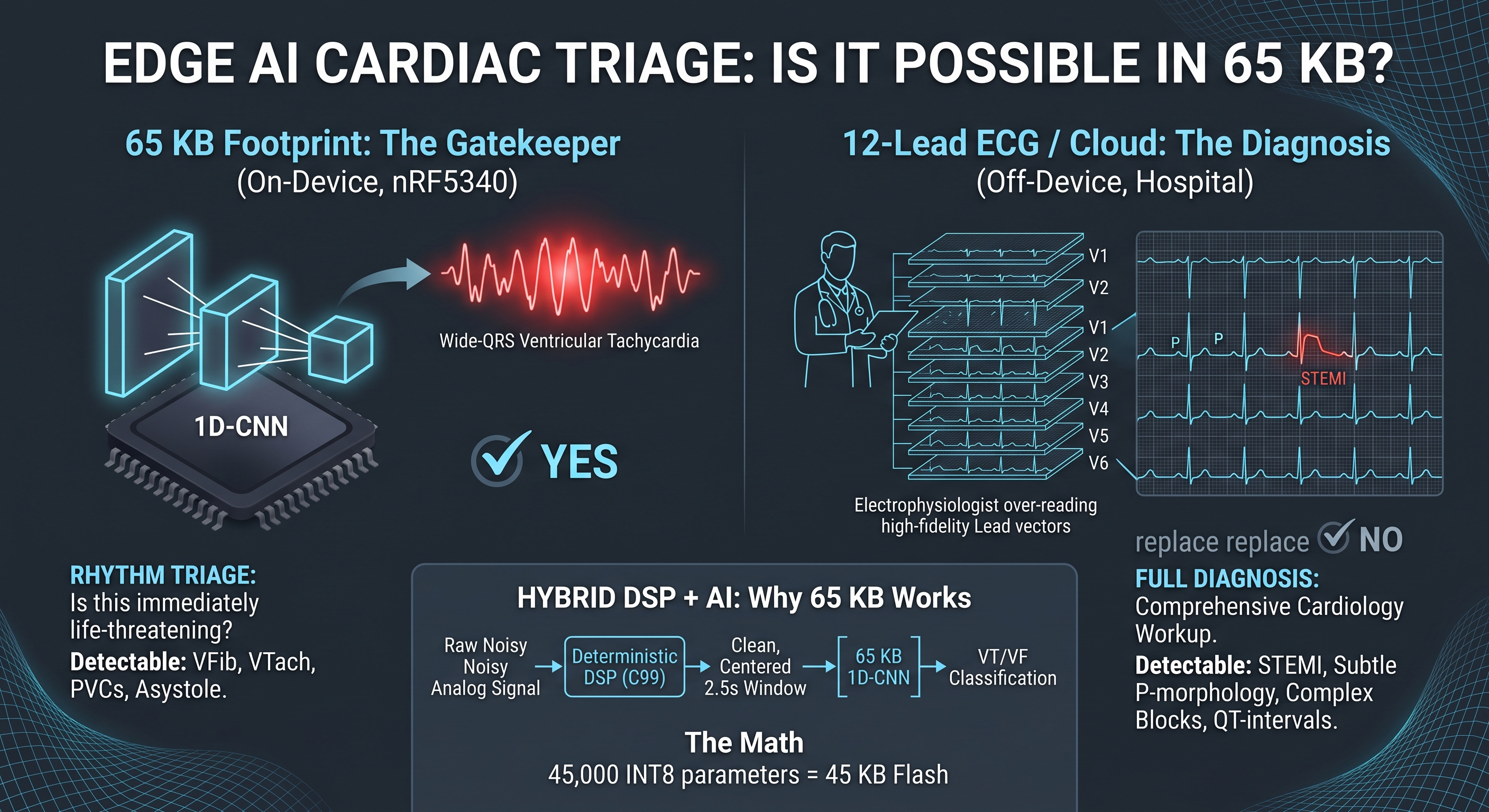
Diagnostic Scope: On-Chip Gatekeeper vs. Off-Device Clinical Diagnosis
| Detectable with 65 KB INT8 1D-CNN (On-Device) | Requires 12-Lead ECG / Cloud Over-Read (Off-Device) |
|---|---|
| Ventricular Fibrillation (VFib): Chaotic, high-amplitude sine-like fibrillatory waves. | ST-Elevation Myocardial Infarction (STEMI): Requires localized spatial anatomical vectors (V1–V6, Leads I–III, aVF) to isolate coronary artery occlusion. |
| Ventricular Tachycardia (VTach): Wide-QRS complexes sustained at elevated rates. | Subtle P-Wave Morphologies: Retrograde P-waves, subtle PR-segment depression (pericarditis), or multi-focal atrial runs. |
| Premature Ventricular Contractions (PVCs): Ectopic, bizarrely shaped beats that deviate sharply from baseline QRS morphology. | Complex Conduction Blocks: Left/Right Bundle Branch Blocks (LBBB/RBBB) requiring multi-axis depolarization tracking. |
| Severe Bradycardia / Asystole: Flatline pauses identified through deterministic R-R interval tracking. | QT Prolongation & Brugada Pattern: Microvolt repolarization shifts easily obscured by movement on a single short dipole. |
The Mathematics Behind a 65 KB Model
In TinyML time-series processing, 1D convolutions operate along a single temporal axis rather than 2D pixel matrices:
- Parameter Efficiency: A 3-block 1D-CNN designed for time-series ECG classification requires only 15,000 to 45,000 parameters.
- Quantized Memory Footprint: At 1 byte per parameter (
int8_t), 45,000 weights consume approximately 45 KB of flash storage. - Compact Temporal Kernels: A 1D convolutional filter of kernel size 7 with 16 feature maps requires just 16 × 7 = 112 bytes.
- Clinical Benchmark Accuracy: Public benchmark evaluations across the PhysioNet MIT-BIH Arrhythmia and VFDB databases demonstrate that 1D-CNN architectures under 50 KB achieve ≥ 98% sensitivity for gross morphological anomalies like Ventricular Fibrillation.
Why the Architecture Works: The Hybrid DSP + AI Engine
The 65 KB neural network does not waste parameter capacity learning powerline hum, baseline drift, or peak alignment. The deterministic bare-metal C99 DSP pipeline handles signal conditioning first:
Raw Noisy Analog ECG (500 Hz via SPI)
              │
              ▼
┌──────────────────────────────────────────┐
│   Deterministic C99 DSP Loop             │
│   • 0.5–45 Hz Bandpass Filtering         │
│   • 50/60 Hz Notch Filtering             │
│   • Pan-Tompkins Peak Alignment          │
└─────────────────────┬────────────────────┘
                      │ Centered, Clean 2.5s Window (625 Samples)
                      ▼
┌──────────────────────────────────────────┐
│   65 KB INT8 1D-CNN Engine               │
│   • Evaluates Morphology Geometric Shape │
│   • Classes: Normal vs. VT/VF vs. Noise  │
└──────────────────────────────────────────┘
Because the neural network evaluates an already-centered, normalized waveform strip, the model weights only need to distinguish gross structural geometry (wide bizarre complexes vs. narrow spikes vs. chaotic sine oscillations).
The Two-Stage Operational Paradigm
- Edge Device (65 KB On-Chip Model): Operates locally on the Nordic nRF5340 ARM Cortex-M33 core. It preserves battery life by keeping the BLE radio asleep during normal sinus rhythms and wakes the system in under 35 ms when a fatal arrhythmia triggers.
- Cloud Platform & Physician Review: Receives the high-resolution telemetry strip transmitted during alert bursts to perform deep historical trend analysis, atrial fibrillation burden calculations, and formal electrophysiologist over-reading.
5. Regulatory Strategy, IEC 62304 Class C & Phased Commercialization
Compliance • 3 Questions- Phase 1 (Commercial D2C General Wellness): BeatIO Pulse launches under the FDA General Wellness Policy for Low Risk Devices. The consumer product focuses on cardiovascular strain, autonomic recovery, continuous HRV, and circadian sleep-wake cardiac patterns, generating immediate subscription SaaS revenue ($19–$29/month).
Data Flywheel: Phase 1 collects millions of hours of real-world patient wear data, continuously refining algorithms and providing an unprecedented training dataset. - Phase 2 (Hospital B2B & SaMD 510(k)): Funded by Phase 1 cash flows, the company completes the formal FDA 510(k) clearance process against established predicates (iRhythm Zio K182877, BioIntelliSense BioButton K201448) for medical reimbursement.
- Zero Dynamic Allocation:
malloc(),calloc(), and dynamic heap creation are strictly prohibited and enforced via compiler checks and static analysis (MISRA-C / CERT-C). All neural scratch buffers, BLE queues, and ring buffers are statically allocated at compile time. - Bit-Exact Automated HIL Testing: Every CI/CD commit is flashed to automated Hardware-in-the-Loop bed-of-nails test fixtures. Standardized MIT-BIH Arrhythmia Database waveforms are electrically injected into the physical ADS1293 inputs. The firmware inference outputs must match 64-bit Python reference calculations within ± 1 Least Significant Bit (LSB) before merging.
The platform does not deliver autonomous therapeutic pacing, defibrillation, or drug delivery. Every diagnostic report, rhythm classification, and EHR export requires explicit review and cryptographic electronic sign-off by a licensed electrophysiologist or cardiologist, keeping the human physician firmly in the loop.
6. Manufacturing Economics, Reimbursement & Circular Sustainability
Commercial • 3 QuestionsIn the clinical healthcare market (specifically the United States), Remote Cardiac Telemetry is reimbursed under CPT codes 93228, 93229, and 93241–93248, providing total reimbursement of $300 to $800+ per study. At a manufacturing cost of ~$17.00 and a wholesale clinic supply price of $75.00–$120.00, the patch yields a 65%–75% gross margin for BeatIO Pulse while providing cardiology practices with lucrative Remote Patient Monitoring (RPM) margins.
Independent economic analyses of legacy reusable Holter fleets reveal severe operational penalties:
- Clinic Sterilization Drag: Hospital staff spend costly manual hours performing medical chemical sterilization, cleaning bio-residue, and repackaging devices.
- Patient Non-Return & Loss: 10% to 15% of reusable sensors are never returned by patients or arrive damaged, requiring expensive clinic replacement.
- Reverse Logistics Burden: Prepaid return shipping, sorting, battery testing, and inventory tracking cost between $25.00 and $35.00 per cycle.
- Conclusion: Single-use sterile patches eliminate hospital inventory headaches, streamline patient onboarding, and guarantee 100% fresh battery chemistry and adhesive reliability for every single patient.
Patients drop their used patch into the prepaid return mailer after 14 days. Returned devices enter an automated disassembly facility where primary lithium cells are recycled, rigid-flex PCBA silicon and copper traces are reclaimed, and polycarbonate/silicone components are channeled to certified reclamation partners. This closed loop satisfies European WEEE directives and medical waste reduction mandates while minimizing environmental impact.
7. Electrical Safety, Defibrillation Protection & EHR Integration
Hospital Systems • 2 QuestionsEmergency resuscitation exposes the patient’s thorax to high-energy defibrillation pulses (2,000 V, up to 360 Joules). BeatIO Pulse integrates high-speed Transient Voltage Suppression (TVS) diodes, current-limiting gas discharge geometries, and a dielectric breakdown barrier. Circuitry clamps the transient spike within nanoseconds, shunting high voltage away from sensitive AFE silicon, preventing skin burns under the electrodes, and allowing the device to recover baseline ECG tracking immediately post-shock.
- Sub-800ms Cloud Latency: Active telemetry streams over secure WebSockets/MQTT into AWS MSK (Managed Streaming for Apache Kafka) and Apache Flink for real-time complex event processing.
- Enterprise EHR: Automated ingestion of diagnostic PDF rhythm strips, structured arrhythmia discrete observations, and physician orders into Epic Systems and Oracle Cerner via HL7 FHIR R4 interfaces.
- Ambulatory PMS Hub (B-UPCH): Out-of-the-box integration supporting 11 leading practice management platforms (Best Practice, Cliniko, Coreplus, Genie/Gentu, HealthTrack, Houston Medical, PPMP, Shexie, Stat Health, TM2/TM3, Zedmed) with secure Australian SMD AS 5552 message delivery.
Technical Summary & Countermeasures Matrix
| Biophysical / Technical Reality | Legacy Wearable Vulnerability | BeatIO Pulse™ Architectural Countermeasure |
|---|---|---|
| Vector Limitations | Misdiagnosing ischemia on 1 lead | Arrhythmia triage scope; 3-channel TI ADS1293 ready; Confirmatory 12-lead triggers |
| 14-Day Adhesion | Skin maceration, peeling, gel drying | High-MVTR 3M 2477P tape (>3,500 g/m²/24h); Axelgaard hydrogel; Active AC 31.25 kHz impedance |
| Bluetooth Disconnect | Silent packet loss or buffer overwrite | On-skin INT8 triage; 16 MB 3-Tier Flash safety machine (Tier 1 VFib write-locked); Prioritized resync |
| Quantization Rounding | Microvolt morphology distortion | Quantization-Aware Training (QAT); Asymmetric Two-Tier AI (Edge triage + Cloud FP32); Lossless raw storage |
| Pre-Revenue Runway Burn | 24–36 mo pre-clearance cash freeze | Phased Commercialization (Phase 1 D2C General Wellness SaaS → Phase 2 Clinical 510(k) SaMD) |
| Single-Use Unit Economics | $17 BOM discarded raises margin fear | High-margin US Medicare MCT reimbursement ($300–$800); Zero hospital cleaning/logistics costs |
| Defibrillation Safety | 360J discharge destroys sensor & burns skin | IEC 60601-1 Type CF Defibrillation-Proof; Nanosecond TVS clamping; 2,000V dielectric barrier |
Ready to Review the Full Medical DMR?
Contact our hardware engineering and regulatory team for complete cleanroom PCBA gerbers, 13-part BOM, and ATE test point fixtures.